
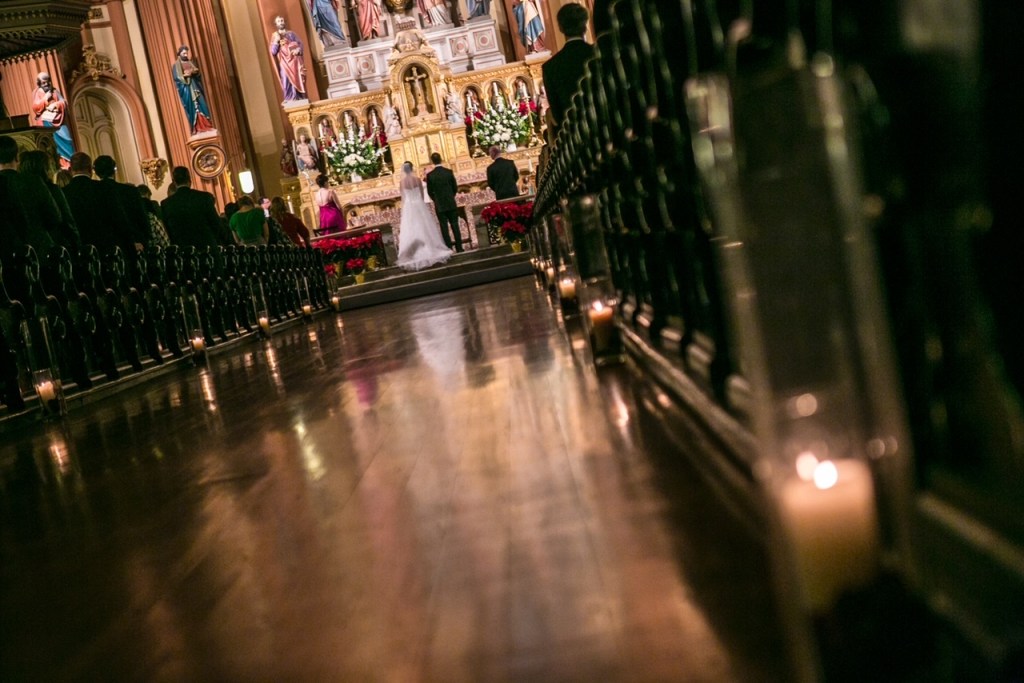
I was the weird college kid who started a Catholic organization at a public University and named it “The Rock”. I bought and wore shirts that honored the papacy. I accidentally wrote a short book at 18 years old to defend the Catholic Church as the one, true Church. I loved my faith then, and I love it now.
I love our current Catholic community. My husband and I are grateful for our faith values and feel incredibly blessed to belong to a thriving church parish near our home with many close friends and cherished acquaintances. We have passionate and caring priests. We have growing ministries and opportunities to come together with other parishioners to grow in our faith. And it is working. There are many parishes like it across the country.
Our beautiful, traditional-style church sits on the corner of two quaint streets where signs currently kiss at a 90 degree angle. One side reads “Save Babies & Help Moms” below a picturesque pregnant woman. Each passerby can see through her belly to the human she houses, as if looking through an x-ray machine. The other side depicts an 8 week old unborn baby. I believe in the mission these signs promote. I wouldn’t want this corner to look any other way.
The annual Mother’s Day Mass brings the joyful bright colors of Spring and the smiling faces of moms who’ve been celebrated with breakfast in bed, homemade crafts from the kids, and hopefully some sweet down time. At Mass, they are often honored with a special blessing. Sometimes gifts are given. And I wouldn’t have it any other way.
Sundays add up over the years. Weekday Masses do, too, when I can make it. Fairs, church-sponsored talks, family picnics, donut Sundays, St. Joseph altars, and school events for our adopted daughter add joy and purpose to our weekly plans. Newborns coo and kick and children age into high school and college before our eyes. We get to witness how families change and grow in the most beautiful ways over time.
And I wouldn’t have it any other way. These families are a gift to us and the world. And while we are so grateful for them and our community, there’s something very different about our family and theirs. Their families keep on growing. Ours stays the same because we are unable to have children.
They likely walk past the signs on our quaint corner without skipping a beat. My heart breaks a little each time I pass them because they’re a frequent reminder of my unanswered longing to personally experience this miracle. The woman who has suffered through miscarriage will surely feel a similar shock of pain.
Mother’s Day Mass has brought various levels of discomfort between different parishes we’ve attended throughout our married life because biological motherhood is often emphasized such that those who are unable to conceive and carry to full term feel further isolated, the value of their incredibly useful gifts of spiritual motherhood seemingly forgotten. Families are praised for being “good, Catholic” ones based solely on the increased number of children.
According to the CDC, infertility inflicts its cruel grip on the lives of 1 in 5 couples, but is often suffered in silence as many men and women don’t feel comfortable talking about it, even within their church community. Some feel the condemning stares of onlookers who assume they’re using birth control. Some feel like they don’t fit in because pregnancy and newborns are not something they can relate to. Some hear priests say things like “the fullness of marriage is lived out through having children” (actually said at a parish) without further context. Some feel so different and insignificant for not being able to reproduce as God intended, and as is so frequently professed from the pulpit, that they hope to fade into the background.
I can’t help but wonder if the absence of a baby is far from the only reason why Catholic couples have such a hard time with infertility. With such an abundant and necessary focus on the gift of new life peeking around just about every church corner, but infertility and miscarriage seldom acknowledged and spiritual motherhood hardly celebrated, these couples can feel like insignificant add-ons who don’t fit in and have little to offer to a booming church community – something that couldn’t be farther from the truth.
The powerful pro-life signs are needed, the support of biological motherhood and growing families are beautiful, and at the same time, without finding ways to balance that with support for those suffering and emphasizing the distinct value of spiritual motherhood, showing up at your local Catholic church can make infertility feel far worse than staying at home. And it’s not necessarily because of what is there, but because of what tends to be missing.
No matter who we are and what our story is, we need community. We need balance. We need education. We need someone to sit with us in our pain. We need each other regardless of whom or what we can produce. The good news is that when our Catholic faith is fully lived out and understood, it is the best place to find the solidarity and support we seek.
Here are some ideas to help your church community balance the messaging and become a recognized source of support and welcome for those who struggle with infertility and miscarriage:
-Talk about it. Find ways to remind the congregation that people with these experiences live in our communities and sit next to us in the pews. Provide opportunities for them to speak and listen if and when they are ready to share their hearts.
-Talk about how all men and women are called to live out their parenthood beyond biological children and to pursue all the ways God has called us to be fruitful.
-Listen to the hearts and stories of women and lovingly educate on Church teaching in opposition to artificial reproductive technologies (ART) like IUI and IVF. Provide trusted resources on scientific and effective alternatives to ART and birth control as treatment, like fertility awareness and Restorative Reproductive Medicine. Browse and contact fabmbase.org and naturalwomanhood.com for resources.
-Before or after the Masses on the Sunday before Mother’s Day, acknowledge how difficult this day can be and assure the women who struggle that the church suffers with them. Celebrate the gift of spiritual motherhood in all women. Email mary.g.bruno@gmail.com for a sample PDF.
-Consider starting a ministry for these women and couples. Include them in meal trains after surgeries and adoptions. Refer to Catholic sites/organizations like springsinthedesert.org, thefruitfulhollow.com, and Catholicinfertilityresources.com.
Being able to claim and express my Catholic faith is one of my most treasured aspects of life, even when some facets are unintentionally veiled or not well understood. Our faith is rich, containing within it a profound love and mercy capable of drawing in even the most distant, sorrowful, and isolated souls. It may not always seem like it at first, but if you’re suffering with a motherhood wound, I hope you’ll look a little closer to find respite in the sanctuary of the Catholic church.


 Mary G Bruno
Leave a comment